Variety:
Crunch the numbers in The Audience -- 46 actors and 28 playwrights, composers and lyricists -- and what you get is one giddy, good-time night in the theater. It was clever of Jack Cummings III, the Transport Group’s Creative Artistic Director, to write a show about the audience attending the final performance of a flop Broadway musical. Cleverer still was his notion to divide that amorphous mob into 18 core groups, each with its own story. But it was altogether inspired of Cummings to assign the creative chores to teams of writers, lyricists and composers who each chose a group of theatergoers and wrote a mini-musical to order.
The collaborative process on this show must have been something to see. (“You take the Four Old Jews.” “No way -- I’ve got the three Staten Island Secretaries.”) What’s surprising is that what has come out of the seemingly chaotic group effort is a smoothly oiled piece about a single, 45-headed character. Real-life audiences will be mortified -- and touched -- to see their own faces in this crowd.
The total of 45 is not counting the playwright (Jack Donahue) of the turkey we keep hearing about but never see. Sitting by himself in the middle of the house at the Gerald Schoenfeld Theater (“Never heard of anything so idiotic in my life,” snorts one of the Four Old Jews. “He’s not even dead”), poor guy is having fits as the audience around him talks, coughs, naps, fidgets, walks out, makes out, switches seats, unwraps candy, uses cell phones and loudly criticizes his maimed masterpiece.
“See all that stuff/Happening up there,” the scribe pleads with this collective beast in his plaintive Jenny Giering-Mark Campbell solo “A Show Going On.” “Can’t you at least/Act as if you care.”
But this is not an easy beast to tame, and in the intricately detailed opening number, “Why Do I Go to the Theater?” musical collaborators Steve Marzullo and Mark Campbell mercilessly nail the sad, sweet, sometimes stupid reasons that compel people to sit in the dark with strangers and stare up at someone’s fantasy about other people’s lives.
Not that anyone is thinking long thoughts in the amusing early sketches about familiar faces like the out-of-town family, the couple on their first date, the two ladies from Westchester, the younger and older gay couples, the assorted parents and their grown offspring and the African-American yuppies deliciously satirized by Keith Byron-Kirk. (“Yes, we are black people/And yes, we are late/We are late ... black ... people.”)
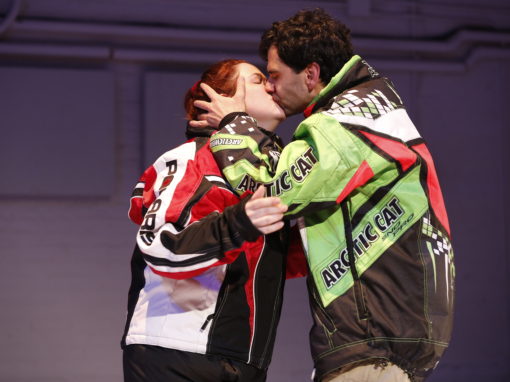
In helmer Cummings’ smoothly integrated design, the audience retains its collective identity while individual members slowly gather definition as sketches are developed. Deftly supported by Duke LaFoon, the divine Dee Hoty takes the cake, in “The Older Woman and the Younger Guy” (penned by Matt Hoverman) as a Gotham sophisticate who celebrates her 50th birthday by seducing the innocent stranger in the next seat. The cackling Marta Curro hilariously eggs on the pack of know-it-alls in Lee Tannen’s “Four Old Jews.” Let loose to misbehave, the gay couples and would-be actresses couldn’t be bitchier or the teenagers sillier.
But as the unseen show (which sounds like something William Finn might have wrought in one of his more neurotic phases) works its emotional magic on fans and foes alike, characters jump out of their thin skins to reveal themselves in more depth.
Rita Gardner injects an honest note of pathos into her comic turn with Sondra Lee as one of the two “Ladies From Westchester” (James Hindman’s contribution). Gerry McIntyre, the preening male member of Keith Byron Kirk’s overbearing “African-American Yuppies,” breaks into an exuberant song-and-dance number by Lewis Flinn and Brian Crawley. Rosemary Loar and Robyn Hussa stand out with soul-baring solos in separate mini-domestic dramas.
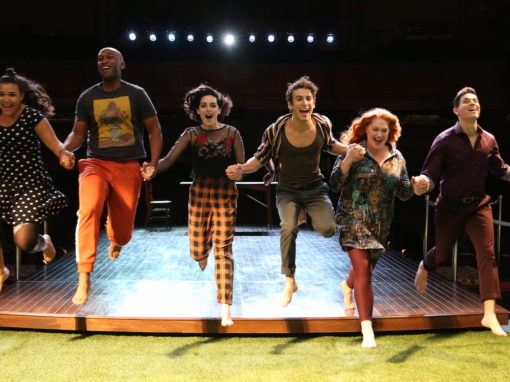
When it’s time for the bows, Michael John LaChiusa gathers the entire ensemble together again in an 11 o’clock number, “Two Joins Three,” that movingly captures the community of the group before it splits and atomizes (“shooting off like sparks”), heading off into the night.
Okay, so it’s corny. But it works like a charm.
The New York Post:
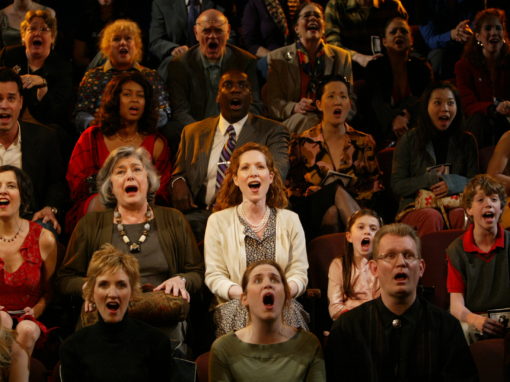
It’s a little disconcerting to enter the Connelly Theatre and come upon a stage filled with row upon row of elevated seats. No, it’s not a mirror effect — just the setting for a unique new musical, The Audience, which provides ample evidence that the only thing more entertaining than watching a good show is watching an audience watching a good show.
Such is the premise of this new production from the Transport Group (First Lady Suite) conceived by Jack Cummings III and representing a collaboration among no fewer than 19 playwrights, 22 composers and lyricists, and a cast of 46. The results fairly burst off the tiny stage of this East Village theater.
As the show within a show begins, a cross section of typical Broadway theatergoers begins to fill the seats. There are Japanese tourists, Jewish kibitzers, obsessed musical theater lovers, Staten Island secretaries, theatrical insiders, even a couple on their first date.
Meanwhile, the harried ushers attempt to deal with cell phone users, people seating themselves in the wrong place, patrons demanding extra Playbills and latecomers.
Over the next 100 minutes, we become privy, though dialogue and song, to the conversations and inner thoughts of the people in the audience, including the show’s writer, who relates his anxieties about what’s transpiring both onstage and in the auditorium in the song “A Show Going On.”
The nearly dozen musical numbers include contributions from such composers as Jeff Blumenkrantz (Urban Cowboy) and Michael John LaChiusa (The Wild Party).
The production is most effective when gently satirizing the rituals of theatergoing and the peccadilloes of boorish audience members who, among other things, keep crinkling candy wrappers.
Ultimately, The Audience provides a delightful theatrical tapestry that will provide laughs of recognition for anyone who’s ever attended a Broadway show.
Entertainment Design Magazine:
Transport Group’s production of The Audience is, in a word, ambitious. Written by 19 different playwrights with songs by 11 different composers, the 2-hour, one act musical purports to tell the tales of the denizens of a typical Broadway show. And boy does it! There is something about The Audience that reminds me of a Cirque du Soleil show: you don’t know where to look because you’re afraid you’re going to miss out on something. That is both a good and a bad thing, because invariably you do miss out on something. However, what you do see and hear is funny and often poignant.
A hint of what the show is about should be obvious from the character descriptions in the program: Four Old Jews, African American Yuppies, Older Gay Couple, Younger Gay Couple, Obsessed Fans, and—my favorite—The Staten Island Secretaries. Every single person reading this column has been in the theatre with the aforementioned stereotypes and I left many out. Directed by Jack Cummings III, The Audience moves along briskly as we are taken on a journey through a Broadway show and we get to see the reactions of a typical audience. From pre-show chatter to intermission and then to post-show wrap up, we get a peek into these people’s lives, loves, and losses. Throughout, we are treated to musical numbers that are the inner thoughts of these characters. Let’s face it, this show could have been three acts as only a handful of the characters get their own numbers. The only composer’s name I recognized was Michael John LaChiusa and his finale, that involved the entire cast of 46, was by far the best piece in the show.
It would be hard to pick a standout in a cast of 46 that is made up of unknowns (to me, anyway) as well as Broadway veterans and past Tony nominees. Jack Donahue is particularly strong as the faux Broadway show’s writer—who apparently received scathing reviews as the show is scheduled to close--and he serves as a link throughout to the other characters, scenes, and musical numbers. Gerry McIntyre has the only show-stopper as the husband in The African-American Yuppie Couple as he sings about the type of Broadway show he would create if given the chance. Eamon Foley as the young son of an Out-of-Town Family also shines as he discovers he actually likes what he’s seeing and indicates what the young boy’s future may hold (see Younger Gay Couple above). However, with a show like this, it is easy to go away wanting more because you only get a glimpse into these people’s lives. One of the most striking vignettes involved the Upper West Side Couple and Their Son played by Herndon Lackey, Leslie Alexander, and Sean MacLaughlin, who gives an especially touching performance as the son who is in his own fantasy world that only we, the real audience, are allowed into.
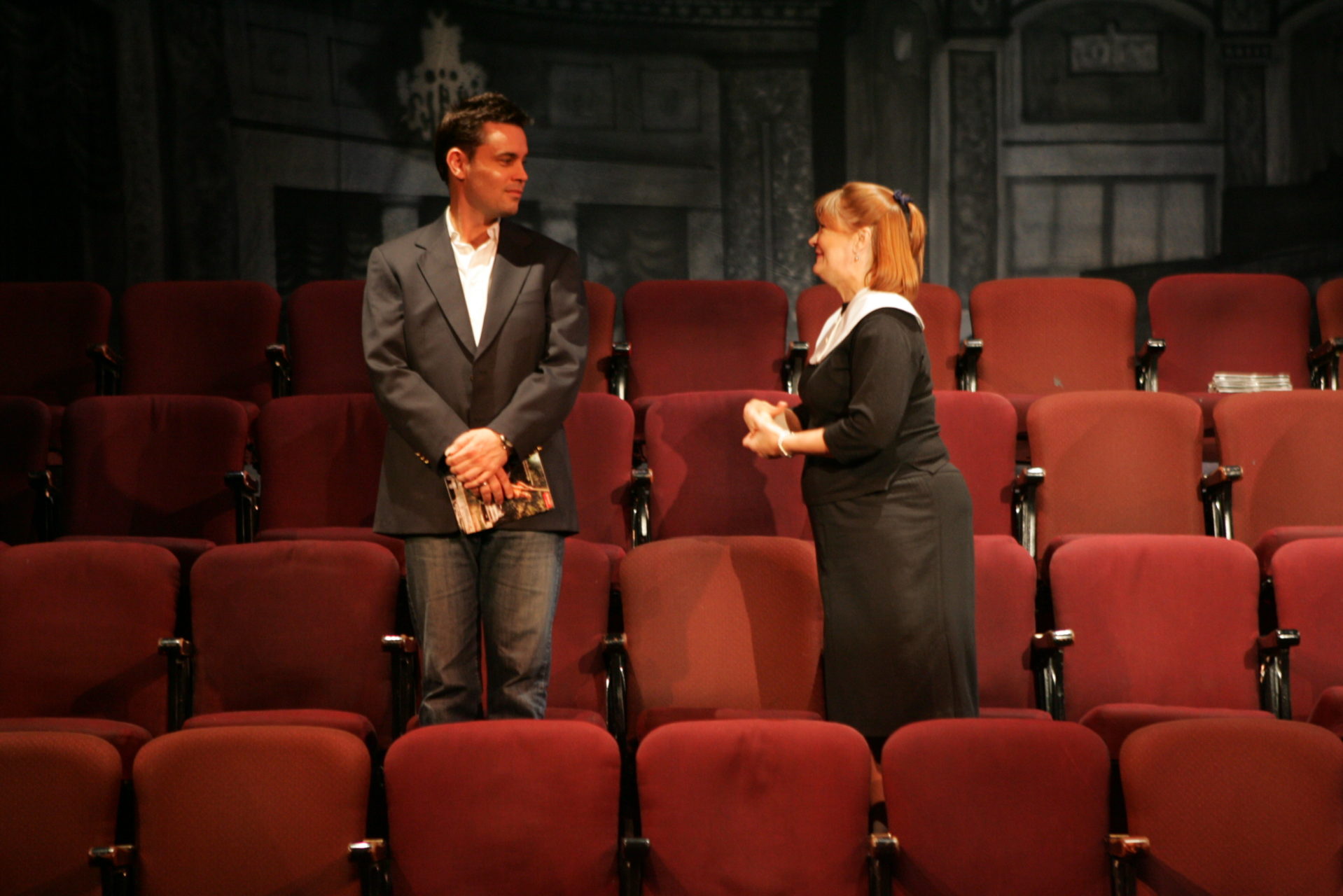
The design for The Audience was simple. Or was it? The stage is a row of nine theatre seats, five stacked rows each (they must’ve been in the mezzanine) and was created by John Story. It perfectly mimics every Broadway theatre’s auditorium. However, I will admit it was off-putting at first to have the entire cast staring back at me for two hours. Wear something nice when you see this show! The lighting by R. Lee Kennedy was brilliant in its subtlety and was amazing in its consistency considering it is a show that is lit with mostly conventional fixtures, which was not an easy task considering how many characters literally get their moment in the spotlight.
During the two numbers that include the full company with solos happening all over the stage, Kennedy relied on four Vari-Lite VL1000TS units to keep the right actors in the right light. One can only imagine the hours the LD spent cueing this show! The costume design is by Kathryn Rohe and was about as perfect as could be considering the variety of every day characters. At least the items were easy to find since the clothing was the same stuff you or I would wear (depending on our own stereotype).
The Audience only plays through April 23rd at the Connelly Theatre in Alphabet City, but if any show deserves a longer life, it is definitely this one. If you like theatre, you should see The Audience just to see how well you’re portrayed!